Friday, June 5, 2015

Event 3- Fowler Museum


I have to say that this museum was awesome. I have been at UCLA for four years and I am ashamed that I have not gone to visit it. When I first walked in the the first that caught my eye was the paintings to my right. The pictures of a building in Spain with the "diablo" and other figures. Second, was the GagaWaka and PostMortem exhibition by Vivan Sundaram. I had to stop and take it in before I even walked around. The first one that caught my attention was the Pill Fill. It caught my eye mainly because it reminded me of someone who abused prescription but also because it was hanging from the ceiling in a glass nylon zipper and it was almost representing death in a different dimension. Another one that was interesting was T Toga or Tampons. I would have never thought that I would see that ever in my life and I did and it was awesome. I also really liked Coffin because it used different dimensions and I like how the organs just seemed to be spread out as if it was on the floor but they looked so pretty and so shiny.


Next, the Lucas Family Gallery, I fell in love with the red "diablo" scene. It reminded me of the day of the dead. I really liked it because of the colors used. It was just so big, so vibrant, and so happy, it was able to put a smile on my face even if it was representing hell and death.
  

Furthermore, was the Sahmat Collective with its incredible use of furniture. There was times in which bricks were used as tables and some things were just sitting on the floor and I liked this. They used the spaces and dimensions of the room. I also liked how protesting slogans can be used as art itself.


Moreover, was the collection of Silver. The ship was incredible and the different sets of cutlery were awesome. Above one of the presentations of art I remember it said "Drinking in Style" and this helps us show how art is incorporated into every level of our social lives. We talked about this I think the first two weeks or so. Here we can see how art was used by the rich to show of wealth. Continuing, this entire museum really showed how art is not something you can just display on walls but on yourself by wearing it, living within it, and creating it. I have to say that is the my favorite museum. Since this is my last event I want to note how every museum incorporated a courtyard or some type of outside feature and I just find it interesting. 


Thursday, June 4, 2015

Event 2- Hammer Museum

For my second event I went to the Hammer Museum. This is my fourth year at UCLA and I have never gone and it really interested me to go because I love museums and this museum is situated in a very weird place because it’s on the corner of two of the busiest streets in West wood and it just looks like a high rise building.


The first thing I want to say is that it’s the weirdest/ most difficult museums that I have ever visited in my life. I say this for one reason only and that is that I had no clue where to go and what galleries I could enter. The first floor was the easiest because it was pretty bright and open and I really like the video that was in one of the rooms. The video was showing different things like 2 range rovers being crushed, people marching down in some parade in Europe, people playing music, children jumping on inflatables. These things showed me destruction, power, and fun all within the realm of art.


Next, the second level I saw the Mary Reid Kelley with Patrick Kelley pictures and they caught my eye right away. The one that caught my eye was the Minotaur with Skull picture. I don’t know why but it did. All the paintings took me back to the week that we talked about the human body and how it is used because in some senses all the images were sexual, because they showed off a woman’s and man’s assets. I also liked how they seemed to be going into the wall because they were pushed in and the walls were white and the paintings were black and white.

Furthermore, the third level was really interesting too not only because of the galleries but the view. That’s really the first thing that caught my eye. Also, the paddle tennis tables. That was surprising and different. Moreover, the chairs were also different, they looked like vases and honestly if people weren't sitting on them I would have just thought that they were empty vases.


In all, to me this was more of a contemporary art museum because it wasn't really displaying much art in a sense of being in rooms for specific art but it used the entire building, the natural light, the outside to make it a museum and even though I appreciate that I honestly did not like that I felt lost.

Sunday, May 31, 2015

Week 9: Space and Art

I really enjoyed this week’s topic because it’s something that I would have never thought of as being part of Art. I didn't even realize how WW2 was integrated and made the shift to the learning of space. Another thing I did not now is that the planets are named after gods except for earth, as mentioned by Abbey Cesna in Names of the Planet its name derives from the German and old English word "ground"; which is honestly really interetsing. Know that I think of it makes sense but I never knew this. Another thing that I found really interesting is that animals were sent into space before humans. As we have seen in previous weeks animals have been used in other areas of art but I didn't know how deep they go into our social structure. I previously mentioned that there should be some limitations to animal use/abuse when it comes to experiments and when I saw Laika in her space home I felt really sad. But, as mentioned in First Dog in Space by Matt Williams "Laika’s sacrifice paved the way for human spaceflight and also taught the Russians a few things about what would be needed in order for a human to survive a spaceflight."


Moreover, I really believe that the competition between the United States and Russia had really did help. In the competition "as each side sought to prove the superiority of its technology, its military firepower and by extension its political- economic system and the world"(The Space Race- History). This was much needed in order to advance this research because without the competition I believe out knowledge of space would have been delayed. Another thing that I am grateful for is that it integrated more math and science into the schools.


What this did make me notice is the amount of money that it costs for such things to be built like an aircraft and stuff. Honestly, saying that it’s extremely expensive seems like an understatement. In a sense it is more reasonable for this to become part of the private sphere because it allows for more funding to the schools that develop such people that study space. On another note, in the beginning professor Vesna mentioned that science exploration is very well incorporated into our social sphere, and I do believe this. Today we don’t hear much about explorations and competitions or even about when a shuttle is going up into space but we do hear a lot about how the things that we do affect our planet earth. Lastly, these explorations have allowed for some of the greatest TV shows like the Jetson's and even within the shows, you have new ideas like the one of the flying car.(Recapping The Jetsons- Episode 03- The Space Car) and also some magnificent art. Like Jeff Foust exclaims in The Space Review "The art was one of the things that made exploration a cultural event. It was very much part of the way we as a culture experienced space exploration, even aside from the photographs, because it was really art that conveyed the excitement. 


References
Williams, Matt. First Dog in Space. Universe Today. Web. Oct 2010

Cessna, Abbey. Names of the Planets.Universe Today. Web. July 2009

History.com Staff. The Space Race. Hstory.com. A&E Networks. 2010. http://www.history.com/topics/space-race

Foust, Jeff. When Space and Art Intersect. The Space Review. Web. Sep 2009
http://www.thespacereview.com/article/1460/1

Novak, Matt. Recapping The Jetsons- Episode 03- The Space Car. The Smithsonian. Web. Oct 2012
http://www.smithsonianmag.com/history/recapping-the-jetsons-episode-03-the-space-car-67174086/?no-ist


Sunday, May 17, 2015

Week 7 Neuroscience and Art'


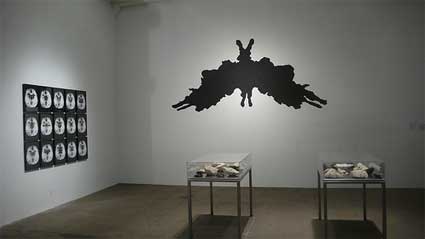
This weeks lectures were really interesting because it talked about different things and some that I never knew were connected. First off, it continues to surprise me the way that art is correlated with science especially the human body. Before when I looked at the images provided in the lectures by Joseph Gall and Paul Broca I just thought of them as a simple illustration but now its an important art form and without it we would never have understood what these artists/scientists were talking about. Suzzane Ankers work was incredible and before this I had never heard of her. In an article by Regine on Suzzane Anker it is explained that Anker used these images because with them, "one begins to assess new meanings:bones, sea creatures, body parts. These are surrogates for the imagination itself, opening up a dialog between the mind and body. What happens when you pick up a psychology test in your hand? The mind essentially has been embodied." (Regine, Common Sence). Which helps explain this new thing with sea sponges. In the article "From Sea Sponge to HIV Medicine" we see that scientists were able to find 2 chemicals that have been used as anti viral and anti cancer drugs. This I think is awesome, which is great because unlike last weeks topic and ethical questions I believe that this use of sea sponges is great and should continue to be used. 

Moreover, I never knew that cocaine and LSD were used to experiment and that people actually wrote books on the dreams they had. I personally also agree that using these drugs are bad and they shouldn't be used to experiment especially on people but I understand that the before people didn't really know about the powerful addiction these drugs have. As expressed in "Effects of Cocaine" from the Drug Free World these drugs are not good to use because people become fiend's meaning with each new dose they want more than the next which leads to death at times. 

In conclusion, this section still leaves me wondering with why do we remember some dreams and not others. Also, what do they mean or do they even mean anything. In an article from the New York Times,  Benedict Carey explains that "Dreams are so rich and have such an authentic feeling that scientists have long assumed they must have a crucial psychological purpose."(Benedict, NY Times) Kendra Cherry also wrote an article and explained they will forever continue to be studied. With this we can see that the brain is a wonderful and mysterious work of art. 

References:
Regine, Brain Waves:Common Sense. March 26, 2008
http://we-make-money-not-art.com/archives/2008/03/brainwave-common-senses.php#.VVmHDjHF81I

"From Sea Sponge to HIV Medicine" Ocean Portal. Find your Portal. Smithsonian Natural Museum of Natural History.
http://ocean.si.edu/ocean-photos/sea-sponge-hiv-medicine

"Effects of Cocaine". Drug Free World. 
http://www.drugfreeworld.org/drugfacts/cocaine/effects-of-cocaine.html

Benedict, Carey. "A Dream Interpretation: Tuneups of the Brain" New York Times. Web. Nov 2009. 
http://www.nytimes.com/2009/11/10/health/10mind.html?_r=0

Cherry, Kendra. "Dream Interpretation, What do dreams mean"About Education
http://psychology.about.com/od/statesofconsciousness/p/dream-interpret.htm


Wednesday, May 13, 2015

Event 1-Natural History Museum


For my first event I went to the Natural History Museum. I want to start of by saying that out of all the times that I have been there, this is honestly the first time that I was able to look at this museum within the concept of art and not history. Something like the Getty is different for me because the Getty has actual paintings on the walls but the Natural History Museum doesn't at least not like the Getty. I say this because, I took my daughter and as I walked into the museum, you notice that its an art piece in itself because its setup to be unique and this architecture is designed/ modeled with artifacts and bones.


The picture below shows, what I would call a 3D figure of Indians Walking West. When I looked at this I felt like I was looking at art and it was not a painting. I always referenced art to drawing and painting, art was whatever Da Vinci, Picasso,  and Kahlo painted. So looking at this 3D figure it hit me that its art. Just like the stuffed animals, that was art and the scenes, they were encompassed in was part of the art. For example, the bison have a backdrop of mountains but the artists put dirt and bones and a stream so that we can have a full picture in our heads. Or the Dinosaur bones, they aren't just sectioned off with labels. The real art is that the artifact is used as a decoration and it makes it much more valuable because you don't only indulge in the beauty of the artifact but in the way that it is displayed.  


Another thing that I really liked were the rock/ mineral collections. I have always found rocks fascinating. I especially love Amethyst. I like how this simple rock/mineral, is something that is part of nature and it grows in nature. It leaves you at awe because this is not something designed it just creates it self some of these things are the most beautiful of the world. So it comes to tell you that are is not just something that someone creates and incorporates into the world but it is something that can create and and replicate it self.


Lastly, I always enjoy coming here because its a place in which you can see a lot of different things, displayed in different forms. I appreciate that now I wont just look at museums as a part of history that is representing an old history but as an art form.
 

Sunday, May 10, 2015

Week 6 Bio Tech and Art

Bio Tech and Art


I put a picture of butterflies because of what was mentioned in Lecture 3 about Diminezas(I dont know how its spelled) and wing modification. I never even thought that one could even try to modify butterflies wings. To me this is incredible, especially since this week I visited the Natural History Museum and I entered the Nature Lab were they have a set of butterflies which you could look closely and really see the details in wings and all the butterflies I looked at were real/not modified. So to think that someone would actually try to do this is crazy and even though it might have beautiful outcomes I think that this is one of those things that goes to far. I say this because after researching what wing color is for, you see that the wing color have a purpose and its usually about, camouflage warning, attraction to mates, deceiving predators and soaking up heat. So by modifying you would essentially get rid of this and make butterflies and predators confused. That is why this is a place in which I believe should have some limitation.


Another section that really influenced me this week was the hybridization of plants and in some sense animals(with the lab rats). I actually know someone who has hybridized two different species of plants and to them this was an achievement. So in some sense I understand what someone like Edward Stichen feels when producing his delphiniums. Also, like Eduardo Kac who makes "Transgenic Art", he put his genes into a plant and created it. I never even thought of this as art so to me this was amazing to see what some artists will do to really create something abstract. Just like Whatley mentioned in The Art of Hybridizing it is "The opportunity to create new things", something unique. 

 Moreover, it might seem weird but after this lecture I will really try to value rats more. I have always known of them being used in experiments for our benefit but I never really valued them and it makes sense what Kathy High said about them. As she mentions in her website, they are powerful tools that we use and that is why we should embrace them.  Even an article by Joseph Castro which mentions that just like us rats are empathetic which makes them our close relatives so we should treat them that way.

In all, I could see why artists feel the need to use technology to help them create abstract art but as mentioned above I do believe that there's boundaries. It's one thing to manipulate a few chemicals in creating something but to try and manipulate human nature that is different and it should be dealt with  differently/ with some rules.

Resources
Gambino, Megan. “The Story of How an Artist created a Genetic Hybrid of Hmself and a Petunia”. Smithsonian. Feb 2013. http://www.smithsonianmag.com/science-nature/the-story-of-how-an-artist-created-a-genetic-hybrid-of-himself-and-a-petunia-25148544/#eO5FxYBM1vXWPI8K.99


Whatley, Oscie. “The Art of Hybridizing”. The Daylily Journal. Americam Hemerocallis. 1990. http://www.daylilies.org/Whatley/WhatleyTheArtOfHybridizing.htm

Kathy High Website - Embracing Animal -http://kathyhigh.com/project-embracing-animal.html

Butterfly Wing Anatomy - http://www.enchantedlearning.com/subjects/butterflies/anatomy/Wings.shtml

Castro, Joseph. “Empathetic Rats Help Each Other Out”. Live Science. Dec 2008. http://www.livescience.com/17378-rats-show-empathy.html


Sunday, April 26, 2015

Week 4

The 3 different lectures we saw all encompassed three different aspects; medicine, science and technology. First off, Lecture one talked about anatomy and art. The first encounter with the anatomy was by doctors who didn’t really know what they were looking at. So, doctors had to work with artists so that the artists could draw correct interpretation of the human body. The first to accomplish this was Versalius. Secondly, Lecture 2 consisted of the human body and medical technologies. This part introduced technology and medicine and one of the first machines used was the X ray. One thing from this section that I found really interesting was the fact that Professor Vesna mentioned that technology was incorporated onto the medical field relatively late. It really only started to be incorporated in the 20th century. Furthermore, another thing that was really interesting to me was the fact that at one point it was said that if you/ doctor used technology you were not considered a doctor. This reminds me of the reading that we had this week on the Hippocratic Oath. This point about not being a doctor if you used technology has drastically changed just like the oath. According to the reading the Oath was binding and the oath explained that a doctor should not help people die, perform abortion, and have sex with patients. All of which have been removed from the modern oath. In another article that I researched about the Oath which is “The Oath, A serpent and A staff” explains the oath has been “replaced by vague generalities” (American Right to Life). Another article I read was “The Hippocratic Oath and the Ethics of Medicine”. This article, talks about Steven Miles who recognizes that times are changing and he wants to “pluck the oath out of its ritualistic niche, refurbish its meaning and show relevance for modern medical ethics.”(Albert Jonsen). Both the articles I researched and the reading for this week include this notion of time and that before it was ok not to use technology but now it’s a must just like procedures that might seem unethical are a must in today’s society. Lastly, professor Vesna talked about the human body and medical technologies. This section focused on plastic surgery and its emergence. For this week we read about Tensegrity and I found another article that also talked about tensegrity and what it is and I liked that it mentioned art and something else that we have talked about in other weeks. It mentioned math and how the tensegrity model is not just a computational model but a sculpture which uses mathematical models to create the dimensions. It’s interesting because this is something we talked about in Week 2 and now again its being incorporated. (Ingber, Donald- Tensegrity 1. Cell structure and Hierarchical systems). Vesna did not mention sexuality, the human body and art. In Katherine Brokks article “12 Famous Drawings reveal how artists interpret the naked human body” talks about how naked limbs and torsos serve the artists to explore sexuality. Another article that I came across that was interesting because it encompassed two concepts that we talked about was an article on Joseph Paul from the Visible Human Project. The Project was for a good cause but what society did to this man goes against Hippocratic’s Oath because the doctors participated in his death. This article explained why Joseph was in jail but it asked an interesting question which was, would they have chosen this body is they knew that Joseph was killed by Lethal Injection? Overall, all topics were really interesting. 

Picture 1: Drawing of the Human Body 

Picture 2: Hippocratic Oath
\
Picture 3: WW1 Plastic Surgery

References:
1.       The Oath by Hippocrates - http://www.pbs.org/wgbh/nova/body/hippocratic-oath-today.html
2.       The Architecture of Life by Ingber D https://cole2.uconline.edu/courses/346337/files/26701924/download?wrap=1
3.       The Hippocratic Oath and the ethics of medicine
4.       The Oath, a Serpent and a staff http://americanrtl.org/Hippocratdic-Oath-Serpent-Staff 
5.       Tensegrity I. Cell structure and hierarchical systems biology by Donald E. Ingber http://citeseerx.ist.psu.edu/viewdoc/download?doi=10.1.1.320.9190&rep=rep1&type=pdf
6.       12 Famous Drawings Reveal How Artists Interpret The Naked Human Body By Katherine Brooks http://www.huffingtonpost.com/2014/08/25/the-nakeds_n_5692887.html
7.       The Visible Human Prisoner? By Vanessa Ruiz